
A double pipe heat exchanger transfers heat between two fluids flowing through separate passages, making it suitable for industrial heating, cooling, and heat recovery. Its simple construction, flexible configuration, and ability to accommodate demanding operating conditions make it a practical option for selected process applications. Understanding its working principle, design requirements, advantages, and limitations helps engineers determine whether this exchanger is suitable for a specific duty.
What Is a Double Pipe Heat Exchanger?
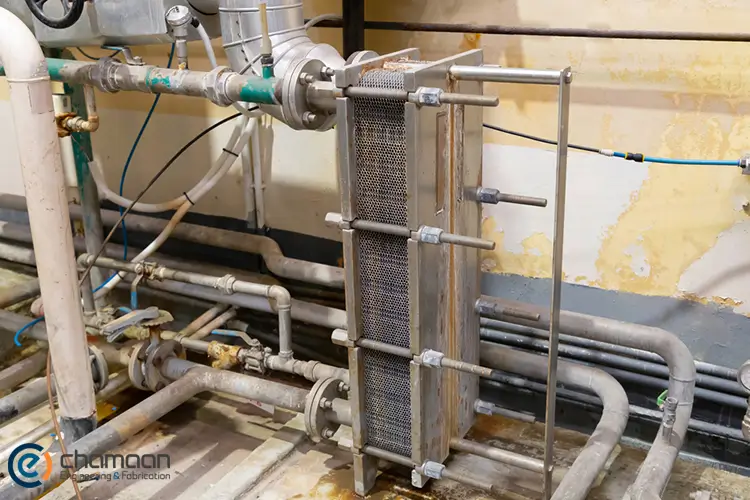
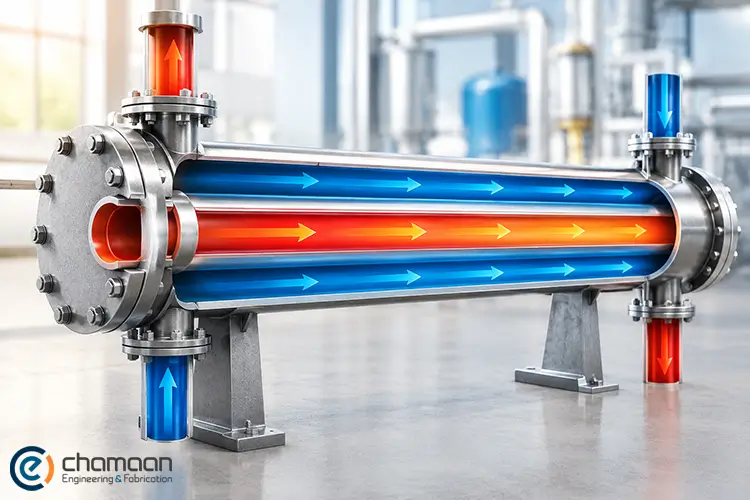
A double pipe heat exchanger is a heat transfer device consisting of two concentric pipes, with one fluid flowing through the inner tube and the other through the annular space between the inner and outer pipes. Heat passes through the inner tube wall without direct contact between the fluids.
Also known as a pipe-in-pipe heat exchanger, this equipment is commonly manufactured in straight sections or U-shaped assemblies called hairpin heat exchangers. The inner tube provides the primary heat transfer surface, while the outer pipe contains the second fluid and directs its flow.
Some designs incorporate longitudinal fins on the inner tube to increase the heat transfer area, particularly when one fluid has a relatively low heat transfer coefficient. The configuration can also be expanded by connecting multiple sections in series or parallel to meet different process requirements.
How Does a Double Pipe Heat Exchanger Work?
A double pipe heat exchanger works by transferring thermal energy from a hotter fluid to a colder fluid through the inner tube wall. Convection transfers heat between each fluid and the pipe surface, while conduction carries it through the metal wall.
The fluids remain physically separated throughout the process. Depending on the application, the exchanger can operate in two main flow arrangements:
- Parallel flow: Both fluids enter from the same end and move in the same direction. The temperature difference is generally greatest near the inlet and decreases along the exchanger.
- Counterflow: The fluids move in opposite directions. This arrangement generally provides a higher log mean temperature difference (LMTD) for comparable terminal temperatures and can achieve closer temperature approaches.
Counterflow is often preferred when thermal performance is important because it maintains a more favorable temperature difference along the heat transfer surface. However, the actual performance also depends on flow rates, fluid properties, exchanger geometry, and pressure drop.
Main Components of a Double Pipe Heat Exchanger
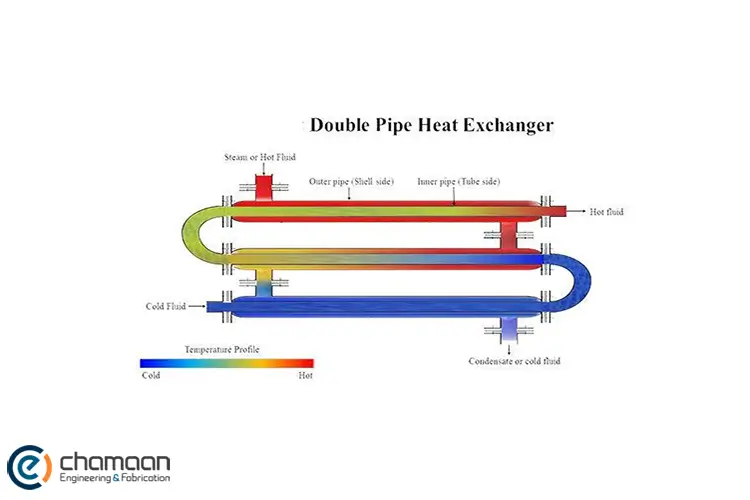
The main components of a double pipe heat exchanger form two separate flow paths and provide the surface needed for heat transfer.
- Inner tube: Carries one process fluid and provides the primary heat transfer surface.
- Outer pipe and annular space: Contain the second fluid and establish its flow passage around the inner tube.
- Inlet and outlet connections: Direct each fluid into and out of the exchanger.
- Return bends and hairpin sections: Reverse the flow direction and allow compact, modular arrangements.
- Fittings, seals, and supports: Connect the sections, maintain mechanical stability, and prevent leakage.
- Longitudinal fins (optional): Increase the available heat transfer area, especially in applications involving gases or other fluids with relatively low heat transfer coefficients.
The material, wall thickness, connection design, and support arrangement must be selected according to the operating pressure, temperature, fluid compatibility, and mechanical requirements.
Double Pipe Heat Exchanger Design Considerations
The design of a double pipe heat exchanger starts with the required heat duty and outlet temperatures, then establishes the surface area, pipe dimensions, materials, and flow conditions needed to achieve the specified performance.
The design process should address the following factors:
- Process conditions: Establish inlet and target outlet temperatures, mass flow rates, operating pressures, and fluid properties for both streams.
- Heat duty: Determine the required heating or cooling load using an energy balance. For a single-phase fluid with approximately constant specific heat, \(Q=\dot m C_p\Delta T\).
- Pipe dimensions and surface area: Select inner and outer pipe diameters, effective length, and any required longitudinal fins.
- Overall heat transfer coefficient: Account for convection on both sides, tube-wall conduction, and fouling resistance.
- Pressure drop: Check frictional and local losses in both passages against the available pumping capacity and process limits.
- Material selection: Consider corrosion resistance, temperature limits, design pressure, mechanical strength, and compatibility with the process fluids.
These calculations are interdependent. For example, increasing flow velocity may improve convective heat transfer but also increase pressure drop. The final design therefore requires thermal and hydraulic checks rather than sizing the exchanger from heat duty alone. For demanding services, mechanical design and applicable pressure-equipment codes must also be verified.
Advantages and Disadvantages of Double Pipe Heat Exchangers
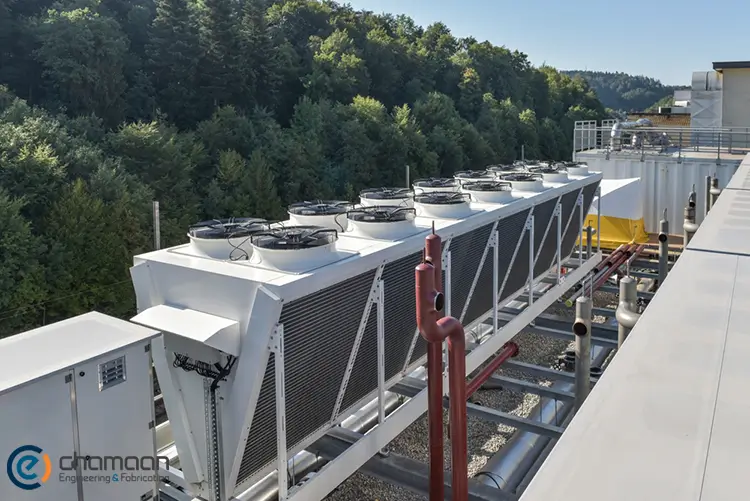
Double pipe heat exchangers offer simple construction and modularity, but their suitability depends on the required heat duty, installation constraints, maintenance needs, and operating conditions.
Advantages
- Simple construction: The straightforward geometry simplifies fabrication and inspection.
- Modular design: Additional sections can be connected in series or parallel when the required capacity increases.
- High-pressure capability: Properly engineered units can handle high pressures and temperatures within their specified design limits.
- Flexible thermal performance: Counterflow arrangements and optional longitudinal fins help meet different heat transfer requirements.
- Maintenance access: Some configurations allow disassembly for inspection and cleaning, depending on their construction.
Disadvantages
- Limited economic scalability: Large heat duties may require extensive piping and numerous sections, making other exchanger types more economical.
- Cleaning challenges: Fouling inside the annulus or inner tube can require disassembly or specialized cleaning procedures.
- Pressure drop: Narrow flow passages, high velocities, and multiple bends can increase hydraulic losses.
- Leakage risk: Multi-section arrangements introduce additional joints and potential leakage points.
- Space requirements: Long hairpin assemblies may require considerable installation length despite their relatively simple geometry.
The key trade-off is between design flexibility and the cost of providing sufficient heat transfer area. A double pipe exchanger is not automatically more efficient or less expensive than alternative designs.
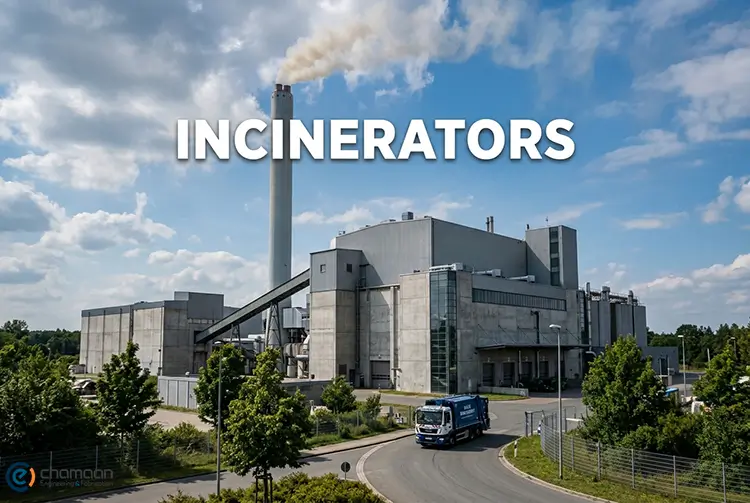
Heat exchangers may also be used for thermal conditioning around an incinerator furnace or in associated heat recovery systems. In hydrogen production facilities using steam reforming, heat recovery is important, although the required duty may call for larger or more specialized exchanger configurations rather than a double pipe unit.
Industrial Applications of Double Pipe Heat Exchangers
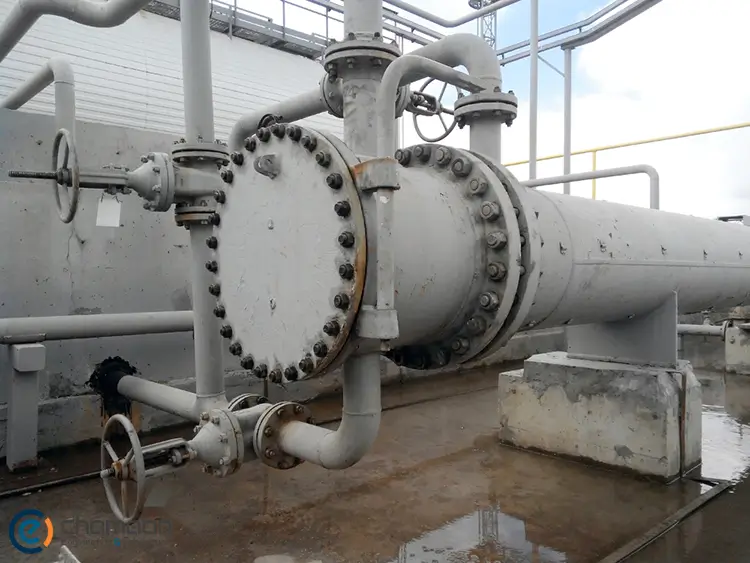
Double pipe heat exchangers are commonly used for process heating and cooling, heat recovery, and services requiring relatively small or moderate heat transfer areas. Their suitability is particularly strong when operating conditions favor a tubular design and a modular configuration.
Typical applications include:
- Oil and gas: Cooling process streams, heating hydrocarbon liquids, and recovering heat between compatible process streams.
- Petrochemical processing: Preheating feed streams before downstream treatment or processing.
- Chemical manufacturing: Heating or cooling liquid reactants under controlled operating conditions.
- Refrigeration: Condensing or evaporating refrigerants in appropriately designed systems.
- Pilot plants: Testing thermal processes where operating conditions or capacity may change during development.
For example, a double pipe exchanger can preheat a liquid feed using a hotter process stream before the feed enters a treatment unit. It can also cool a circulating process liquid before returning it to another stage. In both cases, the design must account for fluid properties, fouling tendencies, temperature limits, and the required heat duty.
In integrated process facilities, heat exchanger selection also affects the thermal requirements of equipment such as a Desalter package, a Dehydration package, or a chemical injection package. These systems have different process functions, so their thermal needs must be assessed individually rather than assuming that a double pipe exchanger is suitable for every package.
Double Pipe vs. Shell-and-Tube Heat Exchanger
A double pipe heat exchanger is generally attractive for smaller duties and modular installations, whereas a shell-and-tube heat exchanger can accommodate a broad range of industrial capacities through a larger tube bundle and shell assembly.
| Criterion | Double Pipe | Shell-and-Tube |
| Construction | Two concentric pipes | Shell containing a tube bundle |
| Typical application | Small to moderate heat duties | Small to very large heat duties |
| Capacity expansion | Add sections in series or parallel | Adapt tube count, shell size, and configuration |
| Installation | Simple, but may need considerable length | Depends on shell dimensions and layout |
| Maintenance | May require disassembly for cleaning | Depends on bundle access and construction |
| Best selection basis | Duty, pressure drop, and modularity | Duty, thermal performance, and lifecycle cost |
Neither design is universally superior. Engineers should compare the required heat transfer area, allowable pressure drop, material costs, cleaning requirements, installation footprint, and total lifecycle cost before selecting an exchanger.
Conclusion
A double pipe heat exchanger is a practical option for industrial heating, cooling, and heat recovery when its thermal capacity and configuration match the process requirements. Reliable selection depends on accurate heat duty calculations, flow arrangement, pressure-drop limits, material compatibility, and maintenance considerations.
At Chamaan, we recognize that heat exchanger selection must align with the wider process design. Contact our engineering team to discuss your process requirements and identify a suitable heat transfer solution.